My Store
Kinich Ahau
Kinich Ahau
Couldn't load pickup availability
Stone remembers.
For centuries, the faces of the ancient Maya that have survived into the present have most often survived because they were carved in stone. Stone endures weather, time, and neglect. It can outlast the people who made it, the buildings that surrounded it, and even the memory of the hands that shaped it.
But stone was never the only material people knew how to work.
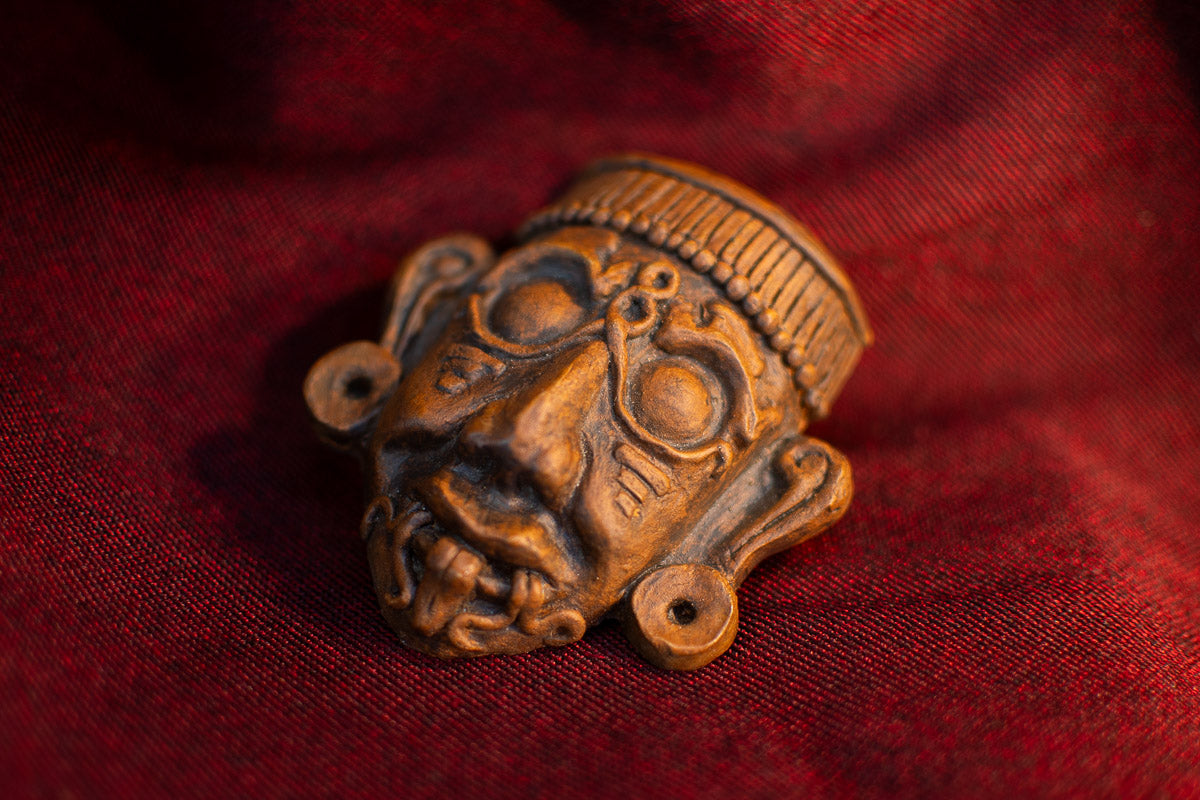
Kinich Ahau is a tribute to the Yucatec Maya Sun God, reimagined in a material that tells a different story.
Rather than stone, this face appears to have been shaped from terracotta—a humble, familiar material, formed by hand and transformed by fire. It is brittle where stone is enduring. It can break. It can disappear.
And that is precisely the point.
When we look backward through history, the objects that remain can give us a distorted picture of the people who made them. What survives is often what was strong enough to survive. What was made of ordinary materials, by ordinary people, may have vanished almost completely.
This Kinich Ahau imagines another possibility.
Not a monument.
Not a relic reserved for a temple.
But something made from the earth itself, in the hands of someone who knew how to shape it.
The face carries the distinctive imagery associated with Kinich Ahau: bold, stylized features and an expression that feels larger than life. Yet the terracotta surface gives him an unexpected warmth. The material feels immediate and human—something that could have been held, touched, painted, placed in a home, or carried into a life that history never recorded.
Much of Maya history was damaged, destroyed, or deliberately suppressed during the centuries following Spanish conquest. Countless works disappeared. Others survived only in fragments, or in drawings and photographs made before they too were lost.
Stone remembers.
But clay remembers differently.
It reminds us that history was not made only by monuments and rulers. It was also made by craftspeople, farmers, builders, families, artists, and countless unnamed people whose everyday lives left behind little that could endure.
Kinich Ahau stands here as a small act of remembrance.
Not claiming to recreate what has been lost.
Not pretending to know what once existed.
Simply imagining the Sun God in another material—one perhaps closer to the hands of the people who lived beneath his light.
A face from the past.
Made from earth.
And brought forward into the present.
This is a piece of magnetic art. It was hand sculpted and cast in durable urethane with a high strength magnet. It is hand painted and may differ slightly from the image above.
Share